The Problem with OpenClaw
OpenClaw is an interesting idea, but in practice it still feels more experimental than dependable.
2026-03-29
OpenClaw is an interesting idea.
It points toward something a lot of people want: a personal cloud computer with AI agents that can write code, run tools, and help you get real work done.
But in practice, OpenClaw still feels more experimental than dependable.
That’s the core problem.
It asks too much from the user
The problem with OpenClaw is not the vision. The vision is compelling.
The problem is that the experience appears too fragile, too complicated, and too expensive for something people want to rely on day to day.
Setup is one issue. OpenClaw can feel like it asks too much from the user before the product becomes useful. There are too many moving parts, too much environment friction, and too much room for things to break.
Reliability is another issue. A system like this only becomes valuable if people can trust it over time. But one of the recurring complaints around OpenClaw is that it can be unstable, that things break too often, and that updates can disrupt workflows that were previously working.
That makes it harder to treat as real infrastructure.
The product often seems to under-deliver
There is also a gap between the hype and the actual experience some users report.
In one popular Reddit thread, a user described OpenClaw as doing “absolutely nothing” for them despite using the official setup with a clean install and documented configuration. They said that instead of acting like a real agent, it behaved like a normal chatbot and failed to actually take actions.[^1]
That kind of complaint matters because agent products live or die on whether they feel genuinely useful in practice.
If users keep wondering whether they missed some hidden setup step, that usually means the product is not yet delivering a reliable default experience.
Cost and efficiency matter more than people think
There is also the efficiency problem.
OpenClaw’s pi coding agent is written in JavaScript. That has real operational consequences. High memory usage means lower agent density, which means fewer concurrent agents per machine and higher infrastructure cost if you want to scale beyond a single session.
That aligns with another recurring complaint: cost. In a separate Reddit thread, users complained that OpenClaw was expensive to run and burned through tokens too quickly to feel practical.[^2]
If your goal is to run a serious multi-agent system, efficiency is not a nice-to-have. It directly determines what is practical on a normal VPS and what gets expensive fast.
Why FileSurf feels different
FileSurf takes a different approach.
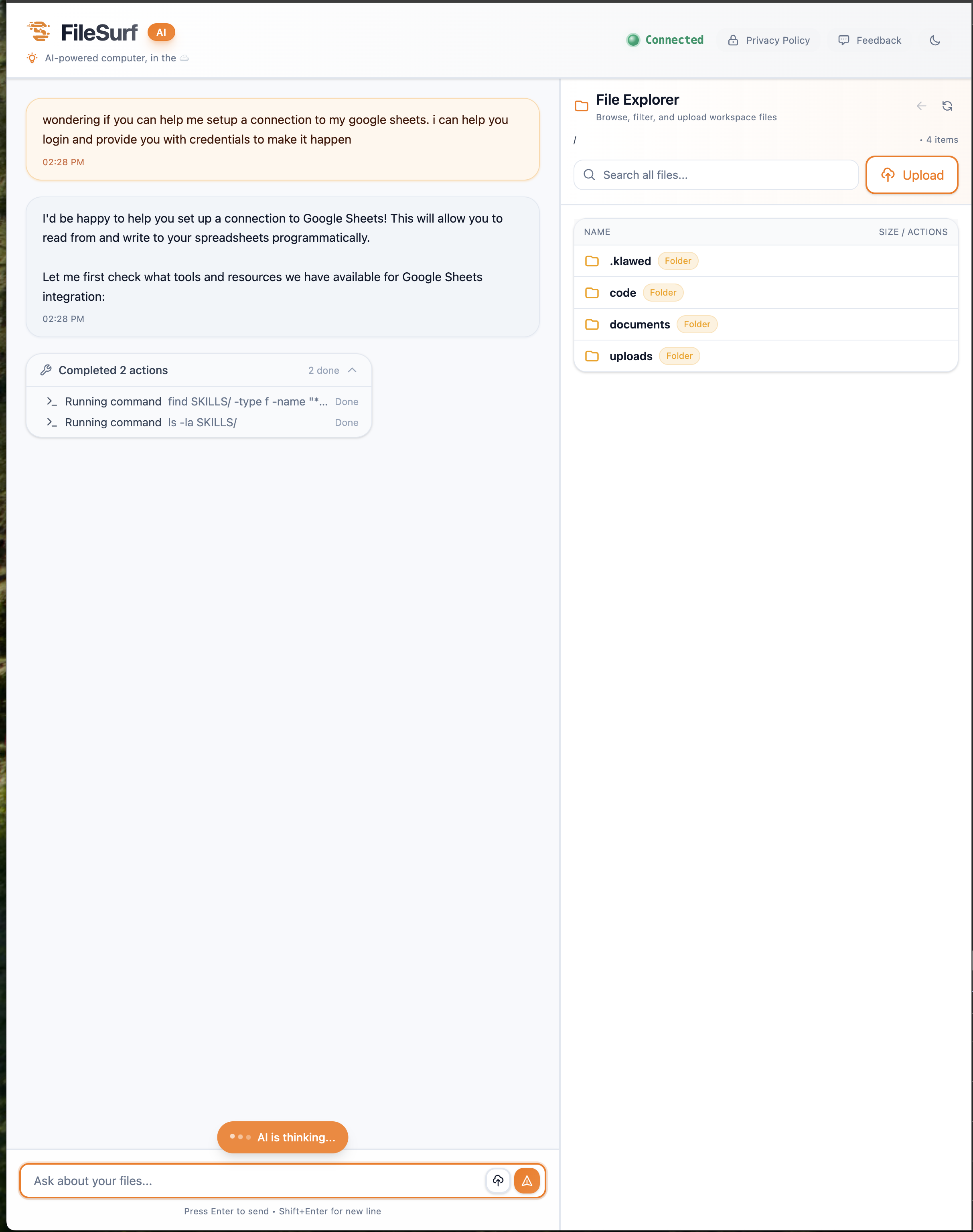
First, it removes the setup burden. You sign up, open it on Mac, iPhone, iPad, or the web, and get to work. There is no self-hosting maze, no environment assembly project, and no feeling that you need to babysit the system before it becomes useful.
Second, it is built around secure sandbox environments with a stronger isolation model. That matters much more once the system becomes persistent, hosts real apps and services, and connects to devices or resources users actually care about.
Third, it is built to scale efficiently.
FileSurf’s coding agent, klawed, is written in C and is extremely lightweight. On startup, each klawed agent uses about 9MB of memory. That means you can run 100 agents using only roughly 1GB of RAM.
That changes the economics of multi-agent systems. Instead of making concurrent agents feel expensive or wasteful, FileSurf makes them practical on modest hardware.
More than an AI coding sandbox
FileSurf is also broader than a coding agent interface.
It is designed as a personal computer in the cloud.
That means it includes the things you need if you want the system to remain useful after the first prompt:
- secure sandboxed environments
- persistent jobs, daemons, and services
- Pages for live web applications running 24/7
- VPN connectivity so the FileSurf AI agent, klawed, can reach devices and services inside your private network
That last point is a major difference.
An AI agent becomes much more useful when it can work across your real environment — your homelab, internal dashboards, SSH targets, private services, and VPN-connected devices — instead of being trapped in a single isolated session.
With FileSurf, the agent is not just there to answer questions or generate code. It can actually operate inside the systems you already use.
Bottom line
OpenClaw is an interesting concept.
But right now, it still feels closer to an experiment than infrastructure.
If you want to tinker, that may be enough.
If you want something you can actually use as a cloud computer every day, the bar is much higher.
That is the problem with OpenClaw.
[^1]: Reddit, “Does OpenClaw actually do anything for you guys?” https://www.reddit.com/r/openclaw/comments/1r0wks3/does_openclaw_actually_do_anything_for_you_guys/ [^2]: Reddit, “How are you actually running OpenClaw without burning money?” https://www.reddit.com/r/openclaw/comments/1s1t8d0/how_are_you_actually_running_openclaw_without/